
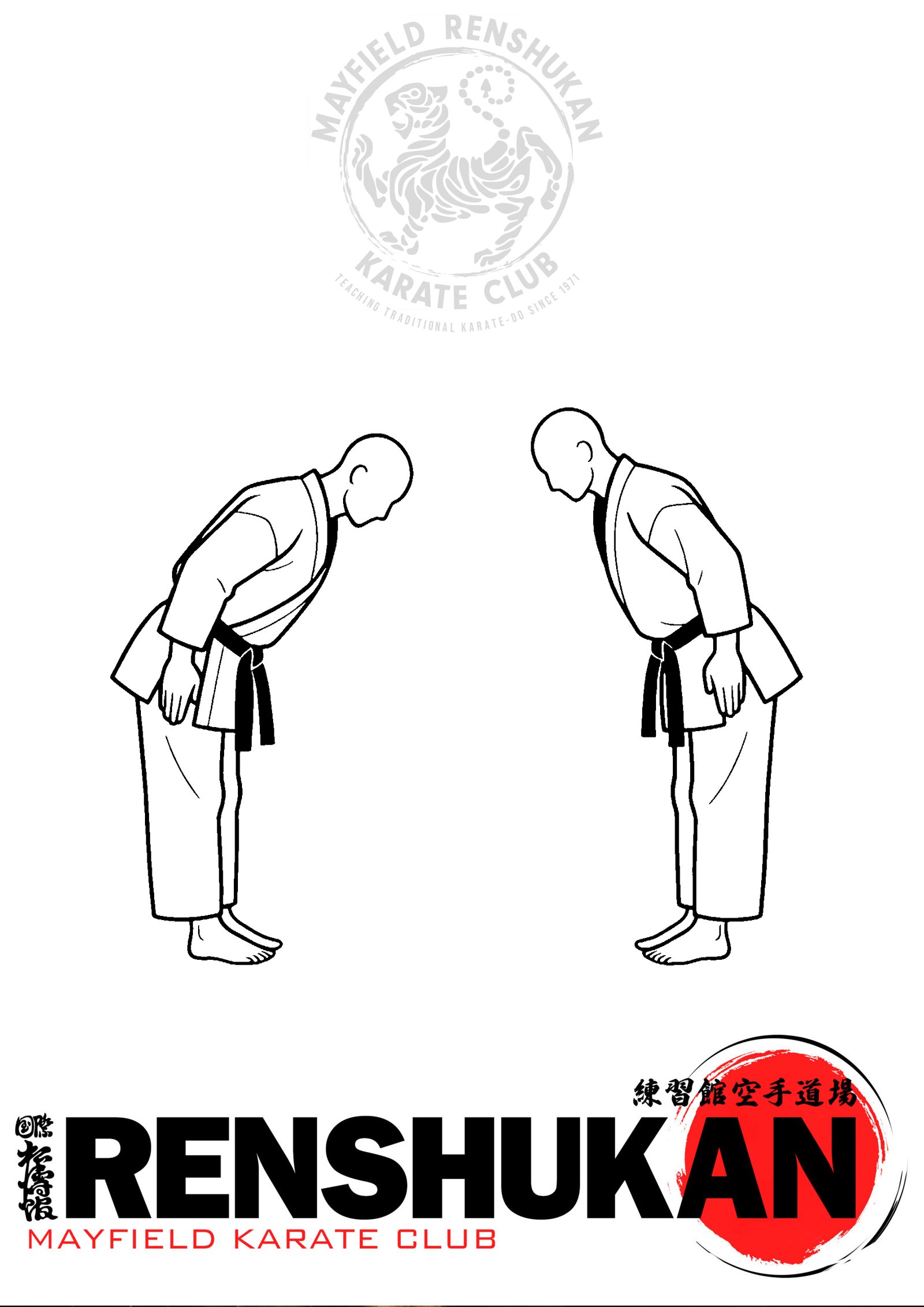
When interacting with others, rei serves as a means of initially displaying respect for a person’s character, contributes to well-balanced relationships between people, and provides a way for preserving social order.
Hirokazu Kanazawa Soke
When we begin training in karate, one of the first things we learn is to bow. We bow when we enter and leave the Dojo. We bow to our instructors. We bow to our fellow karateka. We bow before and after kata and kumite.
It may seem like part of the ritual of karate training, something we do because that is how karate is done, but nothing could be further from the truth. We don’t bow just because we are told to bow. The movement itself has meaning because of what it represents. A bow without respect is nothing more than an empty movement.
WHAT DOES REI MEAN?
The Japanese character 礼 can be associated with courtesy, etiquette, manners and respect. However, in Karate-Do, rei is more than just being polite or performing a bow. Rei establishes a relationship based on mutual respect, trust and understanding.
KARATE BEGINS AND ENDS WITH REI
One of the best-known principles in traditional Shotokan Karate-Do is that karate begins with rei and ends with rei.
Before we begin training, we acknowledge the Dojo, our instructors and our fellow karateka. When training finishes, we acknowledge them again. It creates a clear beginning and end to training, but it also reminds us that karate is not simply about physical technique.
OTAGAI NI REI
Karateka bow to each other because they have responsibilities to one another. Rei acknowledges that relationship. You cannot practise karate properly without another person being willing to train with you.
Respect for your training partner is not optional… it is part of the training.
Rei establishes an understanding: we are here to train seriously, we will challenge each other, but we will also look after one another.
SENSEI NI REI
We bow to our instructor.
This is sometimes misunderstood as showing obedience. The instructor has a responsibility to teach, guide and correct us. They give their time, knowledge and experience to help us improve. The bow acknowledges that contribution.
At the same time, an instructor also has responsibilities to their students. Therefore, the relationship is not simply based on authority. It is based on trust and mutual respect.
REI AND THE DOJO
We bow when entering and leaving the Dojo because the Dojo is more than simply a room where we train. It is the place where we come to learn.
For generations, karateka have entered Dojos to practise the same basic principles of discipline, perseverance, respect, self-control and the constant desire to improve.
Rei also provides us with an opportunity to leave the distractions of everyday life behind and prepare ourselves for training.
REI OUTSIDE THE DOJO
If rei exists only inside the Dojo, then we have misunderstood it.
Karate-Do is supposed to influence the way we live. Kanazawa Soke described Karate-Do as something that should be natural and applied to daily life.
Now, that does not mean walking around bowing to everyone you meet on the street. It means developing an awareness of other people. It means treating people with respect even when there is nothing to be gained from doing so. It means having the humility to recognise that we still have more to learn.
Rei is how we behave towards other people: how we speak to them, how we treat them, how we respond when we are corrected, how we behave when we win or lose, and how we treat someone who is less experienced than ourselves.
Rei may not look like a karate technique, but it is a very important part of Karate-Do.
REI IS PART OF THE JOURNEY
Karate is often described as a martial art, but the word Do (道) means the way or path.
We spend years working on stances, punches, kicks etc. We repeat techniques over and over again, continually looking to improve them. We grade, we compete, we succeed, we fail and we start again, and throughout all of this, rei is a constant.
No matter how long we have trained, or what grade we are, we should never forget the fundamental principles of humility and respect for others.
The lesson is simple: how we train is as important as what we train. To bow correctly takes only a moment.
Oss!