
If good movement is equal to natural movement, then good movement is part of nature and produces a unity with nature.
Hirokazu Kanazawa Soke
In traditional Karate-Do, every movement carries meaning, the movements that seem secondary are often the most crucial for generating true power. Behind every punch, kick, block and stance lies a deeper principle that connects both the body and spirit into one unified action. Two concepts that are often misunderstood, yet are fundamental to traditional karate, are Hikite (the pulling hand) and Hikiashi (the pulling foot).
At first, these movements may appear arbitrary, simply pulling the hand back to the hip or pulling back the leg after kicking. However, they are essential for balance, power generation, timing, control and maximising the impact of every technique. Understanding these concepts is important if one is to understand how traditional karate generates power.
HIKITE – THE PULLING HAND
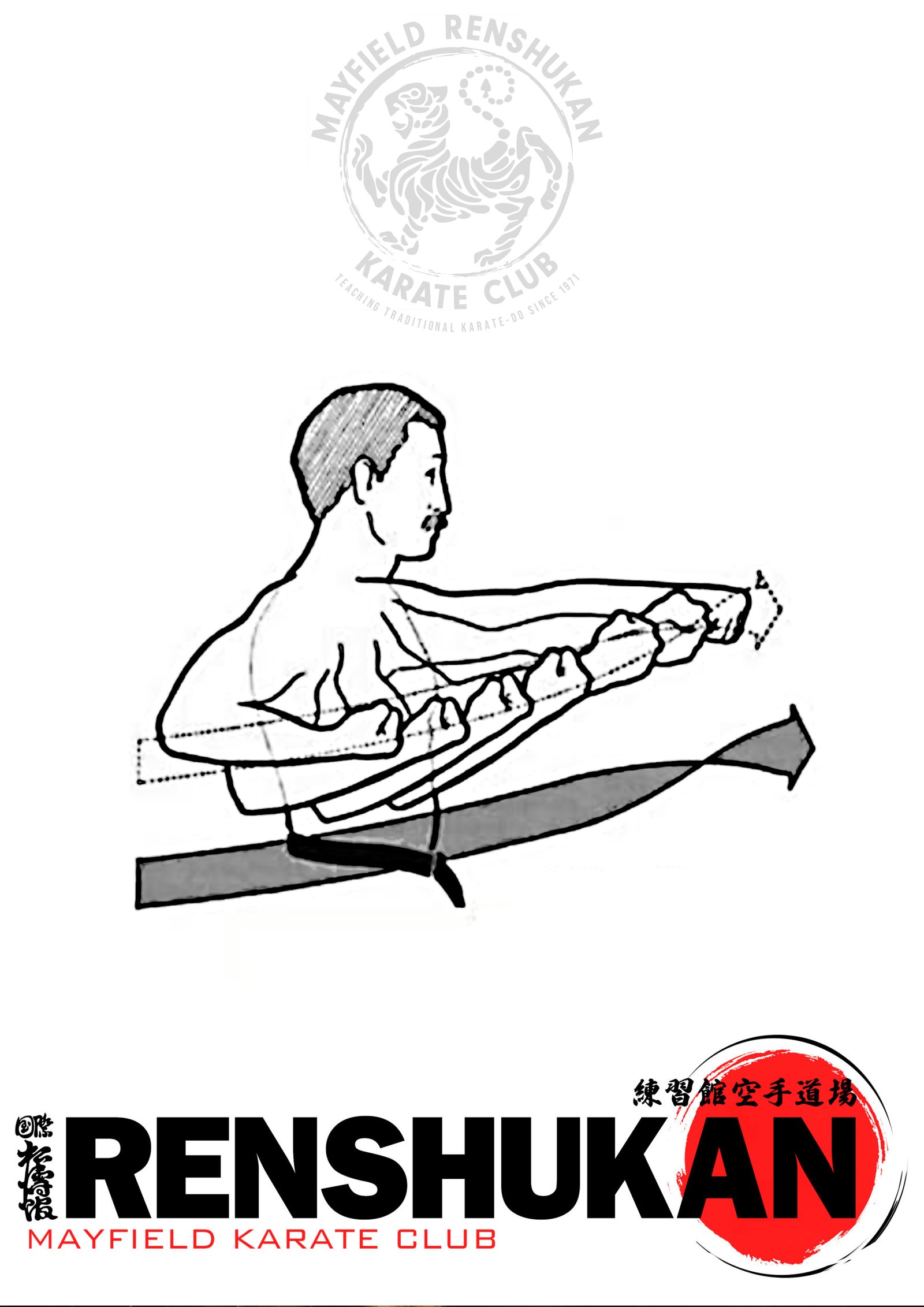
Hikite is the powerful, sharp retraction of the non-striking hand to the hip during a punch, strike or block. Many beginners think this is just a formal movement used for appearance or discipline, however, Hikite is much more than this.
Newton’s Third Law of Motion basically states that for every action, there is an equal and opposite reaction. Very simply put, consider Hikite to be the equal and opposite reaction to your striking hand. A fast, powerful Hikite strengthens the forward striking action allowing the karateka to remain centred through the hara. The action of pulling the Hikite hand back also helps to engage the hips and torso therefore generating a more powerful strike. This hip drive is where the majority of power in Karate is generated, transferring body weight into the strike. The power does not come from just the arm alone, it comes from the entire body working together.
Hikite also has a more practical application. In bunkai, the Hikite hand is rarely inactive. It can be used for controlling your opponent, grabbing, pulling, trapping, or knocking them off-balance while the other hand delivers the technique.
HIKIASHI – THE PULLING FOOT
Hikiashi refers to the rapid retraction of the kicking leg after impact. Instead of dropping the leg straight down after a kick, you actively snap back the leg like a whip into a strong chambered position before resetting your stance.
Hikiashi is also necessary for maintaining balance. After the kick, the leg should return quickly this allows the karateka to recover stability and remain prepared to move again immediately if needed. Smooth, efficient movements through the legs helps with proper weight transfer and engaging the hips. Another important aspect of Hikiashi is Maai (distance). Karateka who understand Hikiashi can attack and retreat without overcommitting or losing balance. This helps with better timing, mobility and efficiency when kicking.
Hikite and Hikiashi are not isolated actions, they are yin and yang. One belongs to the upper body and the other to the lower body, and both share the same underlying principle. Karate-Do is not about brute force, it is the balance between expansion and contraction, push and pull, tension and relaxation. When these principles are practiced correctly, techniques become smoother, stronger, and more natural. The body moves as one rather than as separate parts.
Oss!